Critical Thinking, Children, and Human Agency in the Age of AI Agents
As a child, I was captivated by a book called Lazy Tommy Pumpkinhead.
Published in 1966 by William Pène du Bois, the book tells the story of Tommy, a boy living in a fully automated electric house. His bed wakes him up. Machines guide him through his morning routine. He is washed, dried, dressed, and fed with almost no effort of his own.
Tommy’s entire life is automated.
Then the electricity goes out.
Nearly sixty years after the book was published, I find myself thinking about Tommy once more.
Because, in many ways, we may be building his house ourselves.
Only this time, we aren’t automating the shower.
We’re automating the thinking itself.
As generative AI and AI agents become embedded in education, work and daily life, the debate over AI and critical thinking is becoming more important. The question is not simply whether AI makes us more productive. It is whether routinely outsourcing reasoning, problem-solving and decision-making could change the cognitive skills adults—and especially children—develop and retain.
From Calculators to Cognitive Automation
Humans have always invented technology to make life easier.
Calculators spared us from doing math by hand. Spellcheck caught our typos. Search engines put information at our fingertips. GPS let us forget how to read a map—or even know where we actually were.
Most of this has been enormously beneficial.
I have no desire to wrestle a paper map across my steering wheel just to prove I can drive without Google Maps. It was not pretty 25 years ago.
Technology is meant to take care of unnecessary work for us and make us more productive–sometimes so we can spend more time with family–sometimes because our jobs require it. Long gone are the days of leisurely 2 hours – 3 martini lunches.
But generative AI is starting to take over a different kind of work.
More and more, we ask AI to do things like:
- summarize what we haven’t read;
- explain what we don’t understand;
- generate ideas before we’ve developed our own;
- compare our options;
- write our first drafts;
- challenge arguments;
- recommend what we should do;
- tell us what questions we should be asking.
These are extraordinary capabilities—and I use them myself.
But together, they raise an ethical question we haven’t really grappled with:
What happens to the cognitive skills we no longer need to exercise?
“That Makes Sense” Is Not the Same as Understanding
One of AI’s most remarkable qualities is its ability to make complicated things understandable.
It can organize an argument, simplify an unfamiliar concept and present information in polished, confident language in seconds.
That creates enormous value.
But it can also create an illusion.
We read an AI-generated explanation and think to ourselves:
That makes sense.
But “that makes sense” is not necessarily the same cognitive achievement as:
I worked out why that’s true.
Anyone who’s ever wrestled with a tough problem knows the difference.
The frustration is part of the process. You form a hypothesis. Discover that you’re wrong. Try something else. Find contradictory information. Change your mind. Eventually, something clicks.
The struggle wasn’t an obstacle to understanding.
The struggle helped create the understanding.
How many times have we changed our minds about something after we research the “opposing” side? Now, AI can sometimes transport us directly to the “correct” destination.
The real question is: do we still know how we got there?
How AI Agents Change the Critical-Thinking Equation
This question becomes even more pressing as we transition from generative AI to agentic AI.
A chatbot generally waits for us to initiate something.
An AI agent can now be given a goal, access to information, and the power to act on your behalf.
Imagine your morning a few years from now.
Before you wake up, your AI has reviewed your calendar and email.
It has moved a meeting because it detected a conflict.
It noticed that you’re almost out of coffee and ordered more.
It checked the weather and traffic and adjusted your schedule.
It reviewed the school calendar and reminded your child about an assignment.
It handled three routine emails.
It analyzed your finances and moved money between accounts.
It selected the news and research most relevant to you, summarized it and incorporated the important items into your morning briefing.
It noticed that your afternoon was overloaded and declined a meeting on your behalf.
By the time you pour your first cup of coffee, much of your day has already been handled for you.
That sounds wonderful.
I would happily outsource several of those tasks tomorrow.
But consider something else.
You haven’t made a bad decision all morning.
You haven’t made many decisions at all.
At what point does helpful assistance quietly turn into dependence?
And at what point does convenience begin quietly eroding agency?
How AI Could Affect Critical Thinking in Children
The question gets trickier when it comes to children–this is where I become much less comfortable being the mother to pre-teen and teenage kids, myself.
Most adults today developed fundamental cognitive skills before generative AI existed. We learned to write before ChatGPT could produce a first draft. We researched topics before AI could summarize them. We had to decide which information was relevant.
We got lost. We forgot things. We wrote terrible first paragraphs. We misunderstood assignments. We made arguments that didn’t hold together.
And we got challenged. By our parents, my our friends, my our teachers, by our siblings.
Today’s children will have a very different experience.
For them, AI won’t be a new technology that shows up after they’ve built these abilities. It’ll just be part of the world where those abilities are meant to form.
That creates an important distinction:
There is a fundamental difference between choosing to automate a capability you already possess and never developing that capability in the first place.
Take the debate about AI and homework, for example.
We tend to frame the issue around cheating: Did the student do the work or did AI?
But perhaps that’s not the most important question.
Instead, ask:
What was this assignment designed to make the child’s brain do?
If the purpose was to construct an argument, wrestle with competing evidence, develop an original idea or learn how to communicate that idea, then producing a beautiful paper isn’t the objective.
The cognitive work required to produce it is.
If AI does all that heavy lifting, the student might turn in a better paper—but end up learning less.
Maybe Some Friction Is Good for Us
For decades, technology design has treated friction as the enemy—something to eliminate at all costs.
Fewer steps. Faster answers. Less effort. More automation.
Usually, that’s exactly what we want—less hassle, more speed. But perhaps not all friction is a design flaw. Some friction is actually good for us. Struggling with a problem develops competence. Working through conflicting information develops judgment.
Showing empathy can increase everyone’s humanity.
Getting something wrong and trying again develops persistence. Having nothing to do can produce imagination. Finding your own way develops confidence.
Forming an opinion before hearing everyone else’s develops independent thought. Writing a terrible first draft sometimes helps you figure out what you really think.
The ethical challenge, then, isn’t deciding whether AI should eliminate friction.
It’s deciding which friction makes us better humans.
That question matters even more when we’re designing AI for kids.
The Tommy Test
Lazy Tommy Pumpkinhead actually gives us a surprisingly useful thought experiment for the AI age.
Before handing something meaningful over to AI, try what I’ll call The Tommy Test:
1. What am I actually outsourcing?
Is it a repetitive task? Information retrieval? Creativity? Judgment? Decision-making? Initiative?
2. What skill am I using less because AI is doing this for me?
Sometimes the answer doesn’t matter. I don’t need to preserve my ability to manually schedule five people for a meeting.
Sometimes it matters considerably.
3. Is that a capability I still want to possess?
If AI disappeared tomorrow, could I still do this myself? More importantly, would I notice if the AI was doing it wrong?
4. Am I using AI to replace my thinking—or improve it?
Those are very different uses of the same technology.
For kids, I’d add one more:
5. Has the child had an opportunity to develop the capability before we routinely automate it?
Can we teach them critical thinking early and often?
We don’t need to apply this test to every interaction with AI.
Nobody needs a philosophical debate before letting an agent reorder dishwasher detergent.
But judgment, reasoning, creativity, skepticism, decision-making and the ability to navigate uncertainty deserve more consideration.
AI Could Make Us Better Thinkers
But there’s another possible future—and it’s one I hope we build.
AI doesn’t have to diminish critical thinking. Used differently, it could dramatically improve it.
Instead of asking: What should I think about this?
Ask: What am I missing?
Instead of: Give me the answer.
Try: Challenge my answer.
Ask AI:
- What is the strongest argument against my position?
- Which of my assumptions is weakest?
- What evidence would change this conclusion?
- What perspective haven’t I considered?
- Separate the facts in this argument from the assumptions.
- If my recommendation fails, what will probably have caused the failure?
Suddenly AI isn’t removing intellectual friction.
It’s creating more of it.
Most of us have never had access to an infinitely patient debate partner willing to challenge an idea from ten different perspectives at any hour of the day. Or frankly the patience to listen to us ask what about this way? What happens if we do this? Or, I changed my mind (again!), let’s go to Maine instead of Montana.
Now we do.
Maybe the most valuable thing AI can do isn’t to think for us.
It’s to help us think better.
When the Electricity Goes Out
Lazy Tommy Pumpkinhead was published in 1966, but its central question feels surprisingly current today.
What happens when technology becomes so capable that we no longer need to do things for ourselves?
Tommy discovers the answer when the electricity goes out.
Our version may be harder to see.
AI probably won’t suddenly stop working.
The lights may stay on.
The agents may keep running. Our calendars will remain organized, our emails answered, our information summarized and our decisions optimized.
The real risk might be that nothing breaks at all.
We might simply stop noticing how much we’ve stopped doing ourselves.
The answer isn’t to reject AI. Nor should we deliberately make life difficult simply to prove that humans can still do things the old-fashioned way.
The challenge is more nuanced.
We need to decide what we are comfortable outsourcing—and what remains worth exercising precisely because it is difficult.
That matters for adults.
But it matters even more for children, whose mental habits are still being formed.
The goal isn’t to raise children who can get by without AI—they almost certainly won’t have to, and there’s not much value in preparing them for a world that doesn’t exist anymore.
The real goal is to raise children—and remind ourselves—how to think without AI, and how to think better with it.
Nearly sixty years after Tommy’s automated house first appeared, maybe the lesson isn’t that we should turn off the machines.
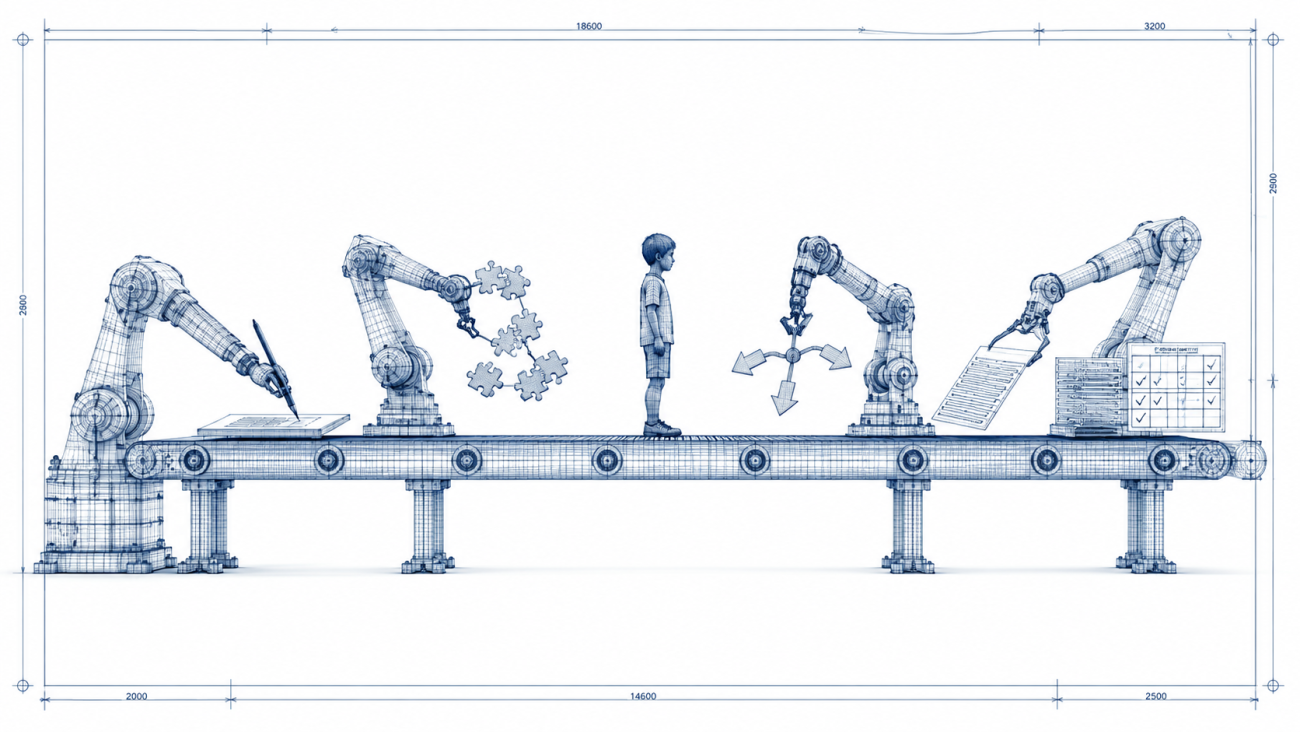
It’s that every so often, we should make sure we still know how to get off the conveyor belt.
