
Part One: A Strategic Permission Framework for AI Use Case Assessment
Executive Summary
Organizations often begin AI use case assessment too late. By the time a proposed use reaches formal governance review, a vendor may already have been selected, a pilot completed, savings promised, and executive sponsorship secured. Governance is then asked to identify the controls required to move the project into production.
That sequence is backward. The first governance decision is not how to control the AI. It is whether the use case deserves the organization’s capital, data, talent, attention, risk capacity, and institutional permission.
Before detailed financial modeling or risk scoring begins, leaders should ask three harder questions: Does the outcome materially advance strategy? Is AI genuinely the best solution? And does the use create value in a way that is consistent with the organization’s mission and defensible to its stakeholders?
These questions form a Strategic Permission Gate. A weak answer should change the route—not be averaged against strengths elsewhere.
AI governance should not exist merely to make proposed projects safer. It should help determine which AI projects deserve to exist at all.
What Is an AI Use Case Assessment
An AI use case assessment is a structured pre-approval process used to determine whether a proposed AI initiative is strategically relevant, genuinely requires AI, and creates value in a way the organization can defend. The assessment should route the proposal to advance, redesign, use simpler technology, remain a bounded experiment, be deprioritized, or stop.
Governance Often Arrives After the Decision Has Quietly Been Made
Many AI initiatives follow a familiar path: a leader identifies an opportunity, a vendor demonstrates a capability, a pilot is launched, and a business case is drafted. Governance is invited after the project has acquired visibility and momentum.
At that point the question is no longer neutral. Instead of asking, “Should we pursue this use case?” the discussion becomes, “What controls must we add so it can proceed?” Business sponsors want the promised benefit, technology teams have committed resources, and senior leaders may already have included expected savings in transformation targets.
Once the organization becomes invested in the solution, risk assessment can become a negotiation over how to approve it. Weak business cases are rescued by optimistic forecasts, mission conflicts become communication issues, and governance risks becoming a service for legitimizing decisions made elsewhere.
Moving governance upstream requires a different concept: strategic permission. Traditional approval asks whether a system satisfies defined requirements. Strategic permission asks whether the use case has earned the right to consume organizational resources and alter how the company treats people, makes decisions, or conducts its work.
A project can pass architecture, cybersecurity, privacy, procurement, and legal reviews and still be a poor use of organizational capacity. NIST’s AI Risk Management Framework supports this contextual view: organizations should consider impacts, resources, requirements, and risk tolerance rather than apply a universal approval formula.
Risk controls determine whether an AI system can operate acceptably. Strategic permission determines whether the organization should invest in making that possible.
The Strategic Permission Gate: An AI Use Case Assessment Framework
Strategic permission should operate as a gate, not another score. Before an organization invests deeply in financial modeling, control design, vendor diligence, or technical implementation, the proposed use case should pass three tests.
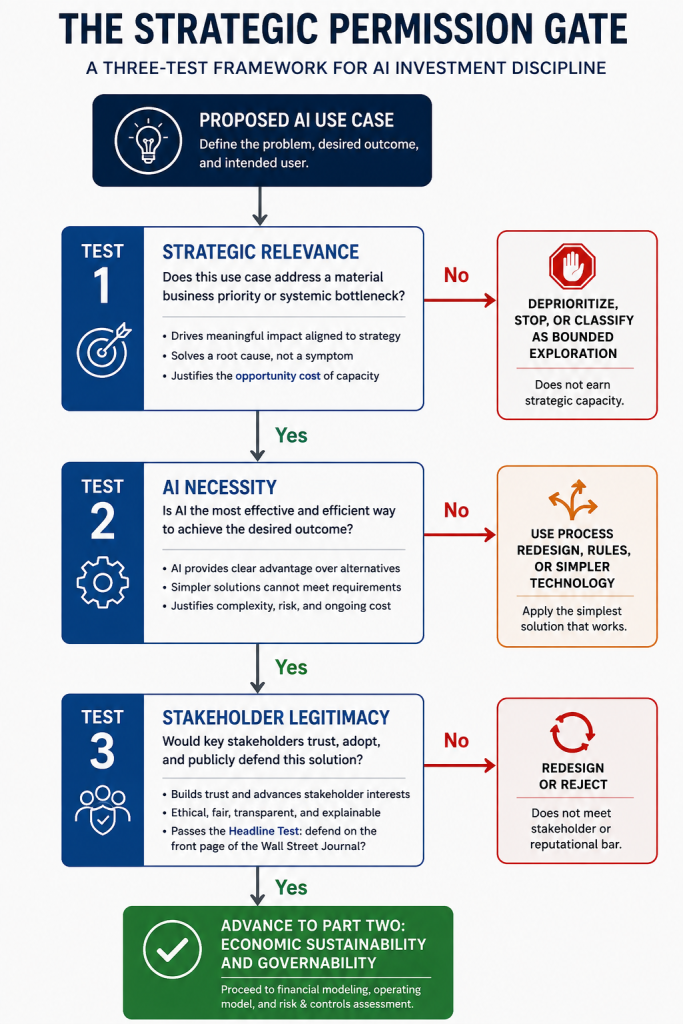
The tests are sequential decisions, not weighted criteria that cancel each other out. A weak result should determine the route: advance, redesign, use simpler technology, run a bounded learning experiment, deprioritize, or stop.
Test One: Assess Strategic Relevance
The first question should not be “What can this AI tool do?” It should be:
What outcome matters enough to justify changing how the organization operates?
Proposed AI use cases are often attached loosely to broad ambitions such as innovation, productivity, customer experience, efficiency, or digital transformation. Those themes are too vague to justify investment. Almost any technology project can claim them.
A credible strategic case identifies the enterprise priority being advanced, the systemic bottleneck or opportunity, the affected stakeholder, the current baseline, the intended measurable outcome, the accountable executive, the consequences of doing nothing, and why this initiative deserves priority now.
Strategic Relevance Is Not the Same as Local Usefulness
An AI assistant that saves several minutes on routine work may be useful. A summarization tool may be convenient. Those benefits can be real without being strategically material. Leaders should distinguish among convenience, usefulness, value, and strategic significance.
Not every convenience deserves enterprise integration, data access, vendor dependency, training, monitoring, and governance. A company can pursue dozens of plausible AI ideas that collectively contribute little to enterprise performance.
The Opportunity Cost of AI Capacity
AI initiatives compete for more than funding. They compete for scarce technical talent, high-quality data, architecture capacity, governance attention, business sponsorship, and organizational change capacity.
When an organization assigns its strongest engineers, risk specialists, and management attention to marginal productivity tools, higher-value transformations may wait. The true cost of a weak use case therefore includes the strategic opportunities the organization can no longer fund, staff, or govern.
This does not mean every AI initiative must transform the enterprise. Low-cost, low-risk productivity uses may be worthwhile. But scarce enterprise capacity should favor material outcomes.
A portfolio crowded with minor AI conveniences can starve the systemic bottlenecks that actually constrain strategy.
Ask What Happens if the Organization Does Nothing
A powerful test of strategic relevance is simple: “What happens if we do not build this?” A strategically material use case should connect to a meaningful consequence—customer attrition, operating delay, persistent control failures, lost revenue, inadequate service capacity, repeated quality problems, a material workforce constraint, safety or resilience, or a capability required to execute strategy.
“Competitors are using AI” may justify investigation. It does not prove that the same use is right for another company, operating model, customer base, or mission.
If the organization cannot state precisely why the outcome matters, it is not ready to evaluate the technology.
Test Two: Determine Whether AI Is Necessary
Many proposed AI initiatives are not AI problems. They are process, data, accountability, policy, knowledge-management, user-experience, or ordinary automation problems with better branding. Adding AI to a broken process may make it faster while also making it harder to explain, monitor, challenge, and repair.
Compare AI With Simpler Alternatives
| Alternative | Question |
| Process redesign | Could unnecessary steps, reviews, or handoffs be removed? |
| Rules or workflow automation | Is the task deterministic enough for conventional software, routing, alerts, approvals, or integrations? |
| Data or knowledge improvement | Is fragmented, unreliable, or inaccessible information the real constraint? |
| Policy or training | Is inconsistency caused by unclear expectations or inadequate capability? |
| Role redesign or staffing | Is the problem inadequate capacity or unclear ownership? |
AI may still be the right choice when it provides capabilities conventional systems cannot reasonably deliver—such as language interpretation, probabilistic prediction, generation, adaptation, pattern recognition, or analysis of large volumes of unstructured information. But those advantages introduce uncertainty, testing requirements, vendor dependencies, human verification, and new privacy, security, fairness, provenance, or intellectual-property concerns.
The question is not whether AI can solve the problem. It is whether AI solves it materially better than the alternatives.
Beware of AI Solutionism
AI solutionism begins with the assumption that AI is the objective, then searches for processes to automate or workflows to redesign around the technology. That reverses sound strategy. Technology should serve the outcome; the outcome should not be invented to justify the technology.
Exploration remains valuable, but it should be identified honestly as exploration. A controlled experiment designed to develop knowledge is different from a production investment justified by a business return.
The financial consequences of solutionism are becoming harder to ignore. PwC argues that enterprise AI costs can continue to rise even as token prices fall because cheaper access encourages broader use, including workflows where AI adds complexity without meaningful differentiation. Its proposed discipline begins by underwriting each use case before it is built: estimate direct and indirect costs, identify likely value, and establish a genuine go/no-go basis.
One diagnostic question cuts through the technology discussion: “If the AI disappeared tomorrow, what underlying problem would remain?” If the answer is unclear policy, poor data, broken handoffs, or bad process design, the organization may be automating symptoms rather than causes.
Test Three: Assess Stakeholder Legitimacy
Corporate mission and values are often treated as brand language. AI governance should force organizations to treat them as operating constraints. A proposed use can be technically feasible, lawful, and financially attractive while still conflicting with what the organization claims to stand for.
A healthcare organization might lower cost while creating unequal access. A financial institution might improve efficiency in a way that conflicts with fair-treatment commitments. An employer might deploy intrusive monitoring while claiming to value trust and autonomy. A customer-service system might reduce expense by making human assistance materially harder to reach.
The OECD AI Principles reinforce that trustworthy AI should align with human rights, fairness, privacy, dignity, autonomy, and appropriate human oversight—not be judged solely by technical performance or organizational benefit.
Mission Alignment Is Not a Soft Score
Many assessment models treat mission or values as a low-weight criterion beside cost, delivery time, and technical feasibility. That is too weak. Some forms of misalignment should not reduce a score by a few points; they should change the decision.
- Does the use advance or undermine the organization’s mission?
- Who receives the benefit, and who bears the inconvenience, scrutiny, risk, or loss?
- Is value being created, or is cost being transferred?
- Does the use contradict commitments on privacy, fairness, safety, accessibility, workforce treatment, or trust?
- Can affected people understand, question, or challenge important outcomes?
The Burden-Transfer Problem
An AI initiative may appear financially attractive because some of its cost is invisible in the sponsoring department’s business case. Customers may have to correct inaccurate records. Employees may verify unreliable outputs. Managers may inherit more exceptions. Control functions may absorb monitoring work. Vulnerable users may struggle with automated service channels.
An AI system that shortens handling time by preventing customers from reaching a person may reduce internal expense while shifting the cost of resolution to the customer. A system that increases employee output may appear productive while also creating verification and rework.
Reducing the organization’s cost is not always the same as creating value.
The Public-Defense Test
Would responsible leaders explain the use openly to the people affected by it—not merely disclose that AI is present, but explain what it does, why it is used, what data it relies on, how it affects people, what human review exists, what happens when it is wrong, and who benefits?
If the system’s logic, data sources, and burden-shifting mechanisms appeared in the financial press tomorrow, could leadership defend the decision plainly—or would it retreat into euphemisms and crisis communications?
A use case should not depend on opacity to remain acceptable. If the business case depends on affected people not understanding the system, it has a legitimacy problem—even if it is legal.
Legality Is a Gate, Not the Opening Argument
Legal and regulatory review is non-negotiable. The EU AI Act, for example, uses a risk-based framework that distinguishes prohibited practices, high-risk systems, transparency obligations, and lower-risk uses. But regulatory classification does not answer the full enterprise question.
A use case can be legally permissible and still be strategically irrelevant, unnecessary, harmful to trust, inferior to a simpler alternative, or unworthy of scarce investment and governance capacity.
The absence of a legal prohibition is not an instruction to proceed. Regulation establishes a floor; corporate governance must establish the organization’s own standard.
How to Evaluate an AI Use Case Before Approval
The Strategic Permission Gate should produce decisions, not averaged points. Use the following sequence before moving a proposal into detailed economics and governability assessment:
- Define the outcome: What problem or opportunity matters, who is affected, and what measurable result should change?
- Establish strategic relevance: Which enterprise objective does it advance, and is it a better use of scarce capacity than competing initiatives?
- Pass the AI necessity test: What non-AI alternatives were considered, and what unique capability does AI add?
- Assess stakeholder legitimacy: Who benefits, who bears the burden, and can leadership defend the arrangement openly?
- Apply legal, policy, and prohibited-use gates: Is the use permissible and within the organization’s own boundaries?
AI Use Case Assessment Decision Matrix
| Strategic Relevance | AI Necessity | Stakeholder Legitimacy | Decision |
| High | Strong | Strong | Advance to economic and governability review |
| High | Unproven | Strong | Compare alternatives or run a time-bound learning experiment |
| High | Strong | Unresolved | Redesign before proceeding |
| Low | Any level | Strong | Deprioritize |
| Any level | Weak | Any level | Use a simpler solution |
| Any level | Any level | Material conflict | Reject or fundamentally redesign |
| Prohibited / unlawful | Any level | Any level | Do not proceed |
A time-bound learning experiment should have a defined question, limited scope, representative data and users, clear success and stop criteria, a fixed end date, a named decision owner, and no automatic path into production.
Sometimes the correct mitigation is not another control. It is stopping the project.
Questions Executives Should Ask Before Approving an AI Use Case
- What important outcome are we trying to achieve, and which strategic priority does it materially advance?
- What happens if we do nothing?
- Why is AI more appropriate than process redesign or conventional automation?
- Who benefits, and who bears the risk, inconvenience, scrutiny, or cost?
- Does the proposal create value or transfer burden?
- Is it consistent with the organization’s mission and public commitments?
- What evidence would cause us to redesign, deprioritize, or stop pursuing it?
A team that cannot answer these questions may be ready to explore. It is not ready for institutional permission.
The Board’s Role: Challenge the Portfolio, Not Every Use Case
Boards should not approve every AI initiative. They should challenge whether management has a disciplined method for deciding which initiatives receive capital and organizational permission.
- Is AI investment tied to explicit strategic priorities?
- Does management distinguish bounded experimentation from production investment?
- Are non-AI alternatives considered before AI is selected?
- Are scarce technical and governance resources directed toward material outcomes?
- Can management identify AI projects it has stopped or deprioritized?
- Does executive sponsorship weaken independent challenge?
A portfolio in which every pilot eventually enters production is not necessarily evidence of successful innovation. It may be evidence that no one is willing—or empowered—to stop a project once the organization becomes invested in it.
Conclusion: Institutional Permission Must Be Earned
Not every AI use case deserves to be built. Some do not address an important problem. Some use AI where conventional technology would work better. Some optimize processes that should be eliminated. Some shift burdens to customers or employees. Some conflict with the company’s mission. Others consume scarce talent and governance capacity that should be directed toward more material outcomes.
AI governance should do more than make proposed systems safer. It should force the organization to decide whether an initiative deserves its capital, data, expertise, attention, risk capacity, and trust.
Before a use case advances, it should demonstrate strategic relevance, genuine AI necessity, and stakeholder legitimacy. Legal permissibility remains essential, but legality is a floor—not a strategy, a business case, or a moral defense.
The strongest AI portfolio will not be the one with the most use cases. It will be the one in which every use case has earned the right to exist.
Coming in Part Two
The AI Pilot Was Cheap. Production May Not Be.
Part Two will examine whether an AI use case remains economically sustainable and governable at production scale, including:
- Context-window inflation and growing retrieval costs
- Agentic cost compounding through planning, tool calls, retries, and sub-agents
- Human-in-the-loop latency and verification cost
- Vendor and model drift
- Infrastructure, integration, monitoring, compliance, incident response, and remediation
It will also examine use-case underwriting, spending attribution, and why cost per reliable business outcome is a more credible measure than cost per token, license, or theoretical hour saved.
A successful pilot proves that AI can perform a task under limited conditions. It does not prove that the economics will survive production scale.
Sources
- National Institute of Standards and Technology. Artificial Intelligence Risk Management Framework (AI RMF 1.0).
- NIST AI Resource Center. AI RMF Core and Profiles.
- OECD. AI Principles.
- European Commission. AI Act: Risk-Based Regulatory Framework.
- PwC. Spending Too Much on AI? How CIOs and CFOs Can Scale AI With Discipline.
