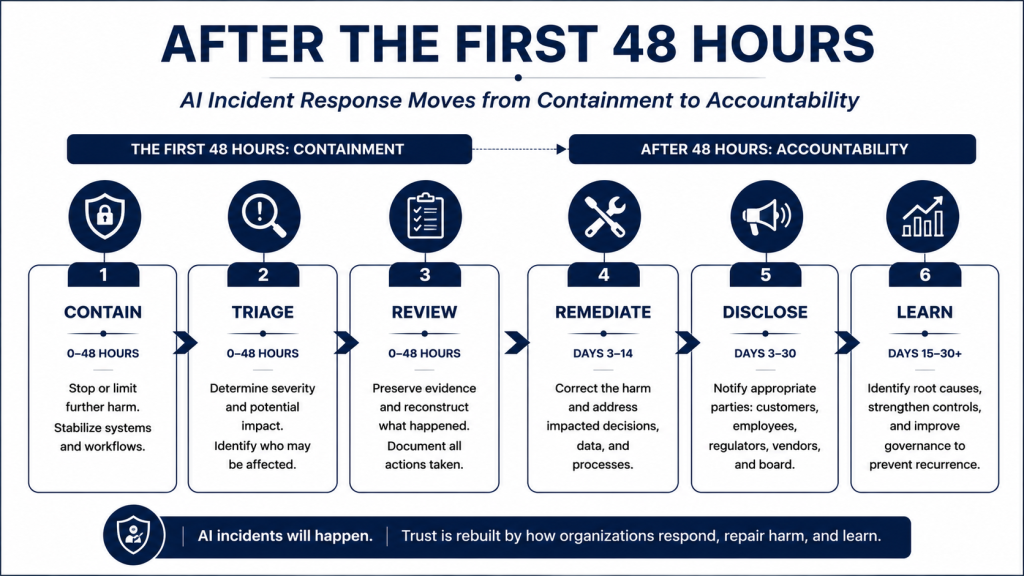
The first phase of AI incident response should be fast and disciplined: contain the incident, triage its impact, and review the situation.
The next phase should be deliberate and accountable: remediate, disclose, learn.
This shift aligns with emerging AI governance expectations. The EU AI Act includes serious-incident reporting obligations for providers of high-risk AI systems, and the European Commission has stated that Article 73 is intended to detect risks early, enable accountability, support quick action, and build public trust. The OECD has also developed definitions for AI incidents and AI hazards, distinguishing between actual harms and circumstances that could plausibly lead to harm. NIST’s AI Risk Management Framework organizes AI risk work around governance, mapping, measurement, and management, emphasizing that AI risk management is a lifecycle discipline, not a one-time approval event.
The regulatory direction is clear enough: AI governance is moving from principles to proof.
Executives should assume that after a serious AI incident, someone may ask:
- What did you know?
- When did you know it?
- What did you do to stop the harm?
- Who was affected?
- What evidence did you preserve?
- What corrective action did you take?
- Why was the system allowed to resume operation?
If the organization cannot answer those questions, it lacks true AI governance. It has optimism and a policy binder, but not accountability.
Step One: Determine Who Was Affected
After containment, the organization must identify the affected population.
That sounds simple. It rarely is.
AI systems often sit inside workflows, not neatly isolated applications. A model may generate a recommendation, summarize account history, draft customer communications, prioritize service requests, screen resumes, score risk, detect fraud, or trigger workflow actions. The model output may be only one part of the process, but it can still shape the final decision.
The review should ask:
- Which customers, employees, applicants, patients, users, or partners were affected?
- Were any groups disproportionately affected?
- Did the system influence access to employment, credit, healthcare, education, housing, insurance, benefits, safety, service, pricing, or legal rights?
- Did humans rely on the AI output as a recommendation or treat it as a decision?
- Were downstream systems updated based on flawed AI output?
- Were records, notices, denials, approvals, scores, or communications generated from the incident period?
The key point:
Remediation must follow the decision trail—not just the model log.
A model may be fixed in minutes. A flawed decision may sit in a customer file, HR record, claims history, audit trail, eligibility determination, or legal communication for months.
If the organization only fixes the technology, it may leave the underlying harm unaddressed.
Step Two: Decide Who Outside the Company Needs to Know
The first 48 hours focus on who must know internally.
After that, the question widens:
Who outside the organization deserves or requires notice?
Not every AI incident requires public disclosure or customer notification. But silence should be a decision, not a reflex.
A practical notification analysis should include:
| Customers or users | They were misled, denied, delayed, overcharged, exposed, or materially affected. |
| Employees or applicants | AI influenced hiring, promotion, discipline, scheduling, termination, performance review, or workplace access. |
| Regulators | Reporting thresholds, sector rules, privacy obligations, safety issues, discrimination concerns, or consumer protection obligations may apply. |
| Business partners | The incident affected shared workflows, contractual commitments, data exchange, or downstream reliance. |
| Vendors | A third-party model, embedded AI feature, API, or platform may have contributed to the issue. |
| Board or board committee | The issue is material, systemic, unresolved, reputationally significant, or tied to regulatory exposure. |
| Public or media | The incident affects public trust, safety, market reliance, or a broad population. |
Legal, compliance, privacy, cybersecurity, communications, business leadership, and risk management should jointly evaluate notification. This cannot be left to the technical team alone.
The technical team may know what failed.
The business knows who relied on it.
Legal and privacy know the obligations.
Communications knows how silence will be interpreted.
Risk and audit know whether the issue points to a larger control failure.
No single function sees the whole incident.
Step Three: Remediate the Harm, Not Just the System
Remediation must be tied to impact.
If the AI system produced inaccurate customer guidance, remediation may require corrected communications.
If it influenced eligibility, remediation may require reviewing affected decisions.
If it produced biased screening results, remediation may require reopening candidate reviews, rerunning decisions, or changing selection criteria.
If it exposed sensitive data, remediation may require privacy notification, security response, access review, deletion, or contractual escalation.
If it triggered an unauthorized workflow, remediation may require reversing transactions, restoring access, compensating affected parties, or documenting exceptions.
A useful remediation review asks:
- What happened to affected individuals or business processes?
- Can the harm be reversed?
- Should decisions made during the incident window be re-reviewed?
- Was anyone denied something they should have received?
- Did anyone receive inaccurate, misleading, or incomplete information?
- Was data exposed, retained, inferred, or reused inappropriately?
- Were the affected people given a meaningful way to challenge the outcome?
- Is compensation, correction, reprocessing, apology, notice, or appeal appropriate?
This is the line executives should keep in view:
An AI incident is not resolved when the model is fixed. It is resolved when the harm has been addressed.
That may be inconvenient, but it is the difference between governance and damage control.
Step Four: Conduct a Real Root-Cause Review
Root cause should not be reduced to “the model was wrong.”
That explanation is usually too shallow.
AI incidents can originate in the model, the data, the workflow, the human-machine interaction, the vendor ecosystem, or the governance process itself. A serious review should examine all of them.
| Model | Did the model behave outside expected limits? Was it poorly validated, poorly monitored, or used beyond its intended purpose? |
| Data | Was the data incomplete, biased, stale, mislabeled, exposed, misused, or outside approved purpose? |
| Workflow | Did the business process over-rely on AI output? Did humans treat a recommendation as a decision? |
| Vendor | Did a third-party model, API, embedded AI feature, data source, or platform change contribute to the incident? |
| Security | Was there prompt injection, unauthorized access, credential misuse, data leakage, or compromised system integrity? |
| Privacy | Was personal, sensitive, regulated, or confidential data processed, retained, inferred, or shared improperly? |
| Governance | Were ownership, approval, monitoring, escalation, logging, or documentation controls missing or ineffective? |
This review should not be performed only by the team closest to the incident. That team may be essential to the facts, but it may also have the strongest incentive to narrow the narrative.
The organization should ask one uncomfortable question:
Did the AI fail, or did our governance fail to control its use?
Often, the honest answer is both.
Step Five: Decide Whether the System Can Restart
Restarting an AI system should require more than technical confidence.
Before resuming use, leaders should confirm:
- The root cause is understood.
- Active harm has stopped.
- Affected decisions have been identified.
- Remediation has been defined or completed.
- Evidence has been preserved.
- Legal, privacy, cybersecurity, compliance, and risk have reviewed where appropriate.
- Vendor issues have been resolved or contractually escalated.
- Monitoring has been improved.
- Human oversight has been clarified.
- The business owner has accepted residual risk.
- Board visibility has been provided if the issue is material.
For high-risk AI systems, the EU AI Act imposes obligations on deployers to use systems in accordance with instructions, assign human oversight to competent and authorized personnel, monitor their operation, and inform providers or authorities when relevant risks are identified. Those expectations point to a broader governance principle: restart decisions should be controlled, documented, and risk-based.
A simple restart gate can help:
| Has the active failure stopped? | Yes |
| Is the root cause understood? | Yes or documented with compensating controls |
| Have affected decisions been reviewed? | Yes or review plan approved |
| Are legal/privacy/security obligations assessed? | Yes |
| Has the business owner accepted residual risk? | Yes |
| Are enhanced monitoring controls in place? | Yes |
| Is there a rollback or pause mechanism? | Yes |
If the organization cannot answer these questions, restarting the system may simply restart the risk.
Step Six: Convert the Incident into Better Governance
The point of post-incident review is not to assign blame and move on.
The point is to improve the system of governance.
Every meaningful AI incident should feed back into:
- AI inventory
- Risk classification
- Vendor review
- Contract terms
- Monitoring requirements
- Data governance
- Logging standards
- Human oversight design
- Training
- Escalation paths
- Board reporting
- Incident response playbooks
- Approval thresholds
- Retirement or decommissioning criteria
If the same type of incident can happen again next quarter, the organization has not learned. It merely recovered.
This is where near misses matter. The OECD’s distinction between AI incidents and AI hazards is useful because organizations should not wait for confirmed harm before improving controls. AI hazards — situations that could plausibly lead to harm — are often the best early warning system.
Examples of AI hazards include:
- Repeated hallucinations in a customer-facing chatbot
- Unexplained model drift
- Employees bypassing human review
- Vendor model changes without notice
- Unexpected use of sensitive data
- AI-generated content being sent externally without review
- Agentic tools taking actions outside approved boundaries
- Complaints about AI-supported decisions
- Inconsistent outcomes across protected or vulnerable groups
A mature organization does not wait for a headline, lawsuit, regulator letter, or whistleblower complaint to act.
It treats credible warning signs as governance inputs.
The Board’s Role After the First 48 Hours
The board does not need to manage the incident.
But it should expect management to explain:
- What happened?
- Who was affected?
- How was harm contained?
- What remediation is being provided?
- Was a vendor or third-party AI system involved?
- Was the incident isolated or systemic?
- Did the organization meet legal, privacy, security, and contractual obligations?
- What evidence was preserved?
- What controls failed?
- What changes will prevent recurrence?
- Is the system still operating?
- Has residual risk been accepted at the right level?
Boards should be particularly alert to incidents involving:
- Customers, employees, or vulnerable populations
- Regulated decisions
- Privacy or cybersecurity exposure
- Financial integrity
- Safety
- Discrimination
- Material operational disruption
- Vendor opacity
- Repeat incidents
- Weak evidence preservation
- Management minimization
The fiduciary question is not whether directors understand every technical detail.
The question is whether they are satisfied that management has a credible system to identify, escalate, correct, and learn from AI failures.
Conclusion: Recovery Is Where Trust Is Rebuilt
The first 48 hours of an AI incident test speed.
The days and weeks after test integrity.
It is possible to contain an AI failure quickly and still fail ethically. That happens when organizations stop the system but ignore affected people. It happens when they patch the model but leave bad decisions in place. It happens when they blame the vendor but do not fix the workflow. It happens when they classify the incident as minor because no one wants to escalate it.
Responsible AI governance requires more.
After the first 48 hours, the organization must move from containment to accountability. It must remediate harm, disclose appropriately, identify root causes, improve controls, and decide carefully whether the system should resume operation.
The future of AI governance will not be judged only by policies, principles, and pre-launch reviews.
It will be judged by what organizations do after AI fails.
Because trust is not rebuilt by saying the system has been fixed.
Trust is rebuilt by proving the organization has learned.
Sources
- EU AI Act, Article 73 (Reporting of Serious Incidents) — ai-act-service-desk.ec.europa.eu/en/ai-act/article-73
- EU AI Act, Article 26 (Obligations of Deployers of High-Risk AI Systems) — ai-act-service-desk.ec.europa.eu/en/ai-act/article-26
- OECD, “Defining AI Incidents and Related Terms” — oecd.ai/en/wonk/defining-ai-incidents-and-hazards
- NIST AI Risk Management Framework (AI RMF 1.0) — nist.gov/itl/ai-risk-management-framework
