Why AI Incident Response Is the Next Test of Responsible Governance
AI governance is shifting from setting principles to managing incidents. As AI systems become integrated into customer channels, business workflows, vendor platforms, data repositories, and automated decision-making, organizations need more than just responsible AI policies and pre-launch reviews. They need a clear process for what to do when AI fails. In the first 48 hours, the key executive question is not who has a general right to know, but who must know soon enough to contain harm, preserve evidence, meet obligations, protect affected parties, and prevent the failure from escalating. This post presents a practical response model for executive teams: Contain. Triage. Review.
Artificial intelligence governance is entering a more demanding phase.
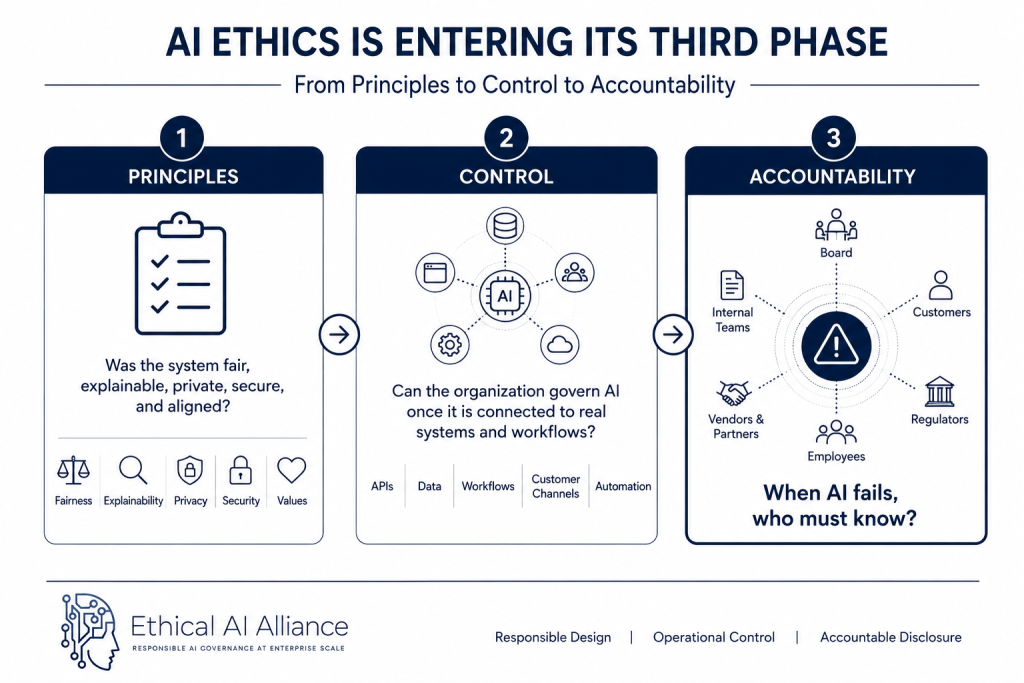
The first phase of AI ethics focused on whether systems were fair, explainable, private, secure, and aligned with organizational values. The next phase asked whether organizations could control AI systems once they were integrated into real business processes, customer channels, data repositories, software tools, and automated workflows.
Now the harder question is emerging:
When AI fails, who must be notified within the first 48 hours?
That question is no longer theoretical.
In June 2026, U.S. Representative Nathaniel Moran introduced the AI Incident Reporting Act, a proposed legislation that would require certain developers of advanced AI systems to report dangerous capabilities, security breaches, and safety incidents to the U.S. Department of Commerce. Reuters reported that the bill would require covered AI companies to notify Commerce within seven days of discovering qualifying dangerous activity, with the most serious incidents escalated to Congress.
Around the same time, the Reserve Bank of India proposed draft guidance for banks using AI and machine-learning models. Reuters reported that the proposed rules would require board-approved model-risk frameworks, ongoing enterprise- and model-level risk assessments, independent validation, human oversight of automated decision-making, cybersecurity safeguards, and corrective action when risk becomes excessive, including restrictions on model use or decommissioning.
The European Union has already moved in a similar direction through the EU AI Act. Providers of high-risk AI systems are subject to serious-incident reporting obligations. The OECD has also worked to define AI incidents and AI hazards so governments and organizations can develop more consistent reporting practices. NIST’s AI Risk Management Framework provides another important signal: responsible AI requires ongoing risk management across the AI lifecycle, not just design-time principles.
The trend is clear: AI governance is shifting from principles to response.
For executives, this shift matters. Responsible AI cannot stop at policy statements, model reviews, vendor questionnaires, or pre-launch approvals. It must include a disciplined process for what happens when something goes wrong.
AI systems will fail. Some failures will be minor. Others will be serious or ambiguous. Failures can be caused by the model, the data, the workflow, the user, the integration, or the surrounding vendor ecosystem.
The ethical question is not whether every AI failure can be prevented.
The ethical question is whether the right people are informed quickly enough, clearly enough, and honestly enough when prevention fails.
Why “Who Must Know?” Is the Better Executive Question
It is tempting to frame disclosure as, “Who has the right to know?”
That is a valid moral question. People affected by AI systems may have a legitimate interest in knowing how decisions were made, what data was used, whether a system malfunctioned, and whether they were harmed.
But in the first 48 hours, executives need a sharper operating question:
Who must know now?
Not everyone needs to know everything. But some people must know enough, soon enough, to act.
Business leaders may need to know so they can stop a flawed process.
Technology teams may need to know so they can contain the system.
Legal and compliance teams may need to know so they can assess obligations.
Data privacy and cybersecurity teams may need to know so they can determine whether data, access, or system integrity has been compromised.
Risk and audit teams may need to know so they can evaluate control failure and repeatability.
Procurement and vendor management may need to know so they can engage vendors, enforce notification obligations, and determine whether contract terms are sufficient.
Communications teams may need to know so they are not improvising if customers, employees, regulators, partners, or media require an explanation.
Executive leadership may need to know so it can direct resources and make decisions that cut across business units.
Boards may need to know when the incident is material, systemic, unresolved, or tied to regulatory, financial, operational, or reputational exposure.
The answer depends on the harm. But silence should not be the default.
In the first 48 hours, silence is rarely neutral. It allows uncertainty, fragmentation, and institutional self-protection to fill the gap.
AI Failure Is Not Just a Technical Event
Executives already understand several categories of organizational failure: cybersecurity incidents, privacy breaches, product defects, service outages, safety events, regulatory violations, financial control failures, and operational losses.
AI incidents can overlap with all of them.
An AI incident may look like a bad model output. But it may also be a privacy event, a security event, a discrimination event, a customer harm event, a vendor oversight failure, a records-management problem, or a board-level operational risk issue.
A chatbot hallucination may be embarrassing. An AI-generated customer communication may be misleading. An automated eligibility decision may be discriminatory. An AI coding assistant may introduce a security vulnerability. An agentic workflow may trigger an unauthorized action. A third-party AI tool may expose confidential data. A model embedded inside a business process may drift away from its approved use.
Each of these scenarios raises different first-48-hour questions:
- Who must know internally?
- Who has the authority to stop the system?
- What evidence must be preserved?
- Has the failure affected people, data, money, rights, safety, or trust?
- Is this an isolated event, a repeatable pattern, or a systemic control failure?
- Is a vendor model, embedded AI feature, or third-party integration involved?
- Does legal, privacy, cybersecurity, or compliance need to assess obligations immediately?
- Does the board need early visibility because the issue may become material?
The OECD’s distinction between an AI incident and an AI hazard is helpful. An AI incident involves actual harm, whether direct or indirect, caused by the development, use, or malfunction of an AI system. An AI hazard is a circumstance that could plausibly lead to such harm.
That distinction matters because organizations often wait until harm is fully proven before escalating an issue. With AI, that delay can be dangerous. AI systems can operate at scale, across geographies, through vendors, and through automated workflows that move faster than ordinary management review.
A near miss may expose a serious control gap. A single customer complaint may reveal a broader pattern. A small failure may be the first visible sign of a problem with a model, data source, integration, workflow, or vendor dependency.
In AI governance, waiting for absolute certainty can itself be negligent.
Example Pattern
Consider an AI-enabled customer service tool that summarizes account history and recommends next steps to frontline employees. The system begins producing inaccurate summaries after a vendor model update. At first, the issue appears to be a few isolated complaints. Then the organization discovers that some customers received incorrect information about fees, eligibility, deadlines, or appeal rights.
The technical fix may be straightforward: adjust the integration, restore the prior model version, or change the retrieval source. But the first-48-hour governance questions are broader. Who knows the issue exists? Who can pause the tool? Were decisions made based on inaccurate summaries? Is the vendor obligated to notify the company of model changes? Do affected business units need to stop relying on the output? Does the law need to preserve evidence? Does data privacy need to assess whether personal data was misused, exposed, or processed outside an approved purpose? Does the board need early notice if the issue reveals a broader control gap?
The point is not that every model error becomes a crisis. The point is that organizations need a disciplined way to quickly distinguish between them.
The Incentive to Minimize
The uncomfortable reality is that organizations often have incentives to downplay AI failures.
They may call the issue an “edge case.”
They may classify it as a vendor problem.
They may treat it as a normal technology defect.
They may argue that the AI system only made a recommendation, even though business teams treated it as a decision.
They may keep the issue inside technical teams because broader escalation is inconvenient, expensive, or reputationally uncomfortable.
They may delay escalation until legal risk is fully understood.
This is where AI ethics becomes real.
A company can have a responsible AI policy and still fail the accountability test when an AI system causes harm. A values statement does not decide who should be notified. A model card does not stop a flawed process. A governance committee is not effective if no one escalates the incident until the damage has spread.
The ethical test of AI governance is not whether the organization claims to use AI responsibly.
The test is what the organization does when AI causes harm.
The First 48 Hours: Critical Escalation Anti-Patterns In the rush to respond to an AI failure, organizations frequently default to institutional self-protection or technical siloes. Avoid these critical missteps:
- Don’t wait for perfect certainty: Escalate credible harm immediately. AI operates at a scale and speed that makes waiting for absolute proof dangerous.
- Don’t isolate the response in IT: Technical teams must not decide escalation thresholds alone. AI failure is a business risk, not just a software bug.
- Don’t delay Legal and Privacy: Bring them in before the technical narrative hardens to properly assess obligations and preserve evidence.
- Don’t treat vendor issues as external: If a third-party model or embedded feature fails, the resulting workflow failure and customer harm belong to you.
- Don’t fix the model while ignoring the process: A quick technical patch (like rolling back a model version) does not address the downstream business decisions that were already made using flawed outputs.
- Don’t close the response without preserving evidence: You will need prompts, outputs, logs, and data pipelines to defend your governance later.
- Don’t let unclear ownership prolong the harm: Containment requires clear authority. Uncertainty over who is allowed to “pull the plug” allows harm to scale.
Legal and Data Privacy Should Help Define the Incident Criteria
Legal and data privacy should not merely be called after an AI incident is declared. They should help define the conditions that make something an AI incident in the first place.
The definition of an AI incident should not be written by technology alone.
Legal, compliance, data privacy, cybersecurity, risk, procurement, technology, and the business should jointly define incident criteria before an incident occurs. Each function sees a different part of the risk.
Legal may recognize regulatory or contractual obligations, litigation exposure, consumer protection issues, employment implications, privilege considerations, or the need for a litigation hold.
Data privacy may identify personal data, consent, retention, purpose limitation, data subject rights, sensitive data, regulated data, or cross-border data concerns.
Cybersecurity may recognize unauthorized access, prompt injection, credential misuse, data leakage, insecure integrations, or compromise of an AI-enabled workflow.
Risk and audit may see a repeatable control failure, a policy breach, or an issue that indicates broader governance weakness.
Procurement and vendor management may identify contract gaps, missing notification duties, weak audit rights, unsupported service levels, or unclear responsibility for vendor model changes.
Technology may identify the model, data pipeline, system, API, platform, integration, or logging failure.
The business owner may understand customer, employee, operational, financial, service, or reputational impact.
This shared definition matters because an AI incident may not announce itself as one. It may first appear as a customer complaint, a bad recommendation, a vendor issue, a workflow error, an unusual data exposure, or a model performance problem.
By the time the organization realizes the issue crosses legal, privacy, security, operational, or ethical boundaries, critical evidence may already be gone.
In the first 48 hours, legal and data privacy are not bureaucratic speed bumps. They are part of containment.
The First 48 Hours: Contain, Triage, Review
AI incident response should not begin with reputation management.
It should begin with harm control.
A practical first-48-hour response model can be summarized in three steps:
Contain. Triage. Review.
The broader lifecycle includes remediation and learning, but the first 48 hours serve a narrower purpose: to stop harm from scaling, determine severity, and preserve sufficient evidence to support responsible decisions.
Executive Takeaway
In the first 48 hours, AI incident response should answer three questions:
Contain: Can we stop or limit the harm?
Triage: Do we understand severity and who may be affected?
Review: Can we reconstruct what happened with evidence?
If the answer to any of these is no, the organization is not ready for responsible AI at scale.
1. Contain
Containment means limiting additional harm.
This may require pausing a model, disabling an AI-enabled workflow, restricting data access, suspending an API integration, reverting to human review, removing a customer-facing AI feature, or temporarily stopping use of a third-party AI tool.
Containment should not require a philosophical debate in the middle of a crisis.
If an AI system is exposing data, producing harmful outputs, bypassing approved controls, making unauthorized recommendations, or acting outside its approved scope, the organization needs a clear path to quickly stop or limit the system.
Containment should also include preserving the legal, privacy, and technical evidence needed to understand what happened.
This is not only a technical control. It is an ethical obligation.
The first duty is to prevent harm from scaling.
For executives, the containment question is direct: who has the authority to pause the system?
If the answer depends on a meeting that has not been scheduled, a vendor that is not contractually obligated to respond, or a business owner who does not know they own the AI risk, then the organization does not have operational control. It has an aspiration.
2. Triage
Triage means determining severity and routing the incident to the right people.
Containment stops the bleeding. Triage decides how serious the wound is. These are different disciplines, and organizations that blur them either over-escalate minor issues (burning credibility with leadership) or under-escalate serious ones (allowing harm to compound while the technical team debates whether the problem is “really that bad”).
Triage answers three questions simultaneously: How severe is this? Who is affected? And who inside the organization must act now?
Severity Classification
Organizations need defined severity tiers before an incident occurs. Ad-hoc severity judgments made under pressure default to institutional self-interest, not honest assessment.
A practical classification might use three levels:
Level 1 — Isolated, Low Impact. The AI system produced an incorrect or unexpected output. The issue is contained to a small number of users, transactions, or decisions. No personal data exposure, no safety implications, no regulatory reporting triggered. The technical and business owners can resolve without broader escalation.
Level 2 — Broader Impact, Potential Obligations. The failure affects multiple users, workflows, or business decisions. Legal, regulatory, contractual, privacy, or cybersecurity implications are plausible but not yet confirmed. The issue may involve a vendor model, an embedded AI feature, or a cross-functional workflow. Legal, data privacy, risk, and the relevant business function must be brought in to assess obligations and exposure.
Level 3 — Material Harm, Executive Visibility Required. The incident involves confirmed or credible harm to customers, employees, safety, financial integrity, legal rights, or data security. Regulatory reporting thresholds may be met. The incident may reveal a systemic control failure rather than an isolated event. Executive leadership must be notified. Board visibility should be evaluated. Communications should be prepared.
These tiers are a starting point, not a final answer. The organization should refine them based on its own risk appetite, regulatory environment, and AI portfolio. But any defined classification is better than leaving severity to judgment calls made by the team closest to the failure — the team with the strongest incentive to classify it as minor.
Scoping the Blast Radius
Severity classification is not enough by itself. Triage must also establish the scope of the incident: how far has the harm traveled, and is it still moving?
The scoping questions include:
- How many users, customers, decisions, or transactions were affected?
- Is the impact ongoing, or has containment stopped the active harm?
- Is this a single AI system, or has the failure propagated into downstream workflows, data sources, or dependent systems?
- Was personal, sensitive, regulated, confidential, or proprietary data involved?
- Is a third-party model, vendor platform, or embedded AI feature implicated?
- Is this an isolated event, a recurring pattern, or a first indicator of a broader control gap?
Scoping determines whether the organization is dealing with a defect or a systemic issue. A single incorrect output from one model is a Level 1 incident. The same model producing incorrect outputs across multiple business units because it was embedded in a shared workflow is a Level 2 or Level 3 — not because the technical failure was different, but because the organizational exposure was.
The Triage Trap
The most dangerous failure mode in triage is not misclassifying severity. It is reclassifying severity downward as more people get involved.
An incident enters triage as a potential Level 2. Legal notes that no regulatory reporting threshold has clearly been met. The business owner argues the customer impact is manageable. The technical team reports the model has been reverted. The incident is quietly reclassified to Level 1 and closed.
Six weeks later, the organization discovers that decisions made using the flawed model outputs were never reviewed, that affected customers were never notified, and that the vendor made the same undisclosed model change to three other clients.
Triage must resist the gravitational pull of minimization. Severity can be reclassified upward as new facts emerge. Reclassifying downward should require the same cross-functional agreement that the original classification required — not a unilateral decision by the function with the most to lose.
3. Review
Review means reconstructing what happened.
This requires evidence, not speculation.
For traditional systems, organizations may rely on application logs, access records, change history, incident tickets, and approval trails. AI systems require additional evidence: prompts, inputs, outputs, model versions, retrieval sources, fine-tuning data, policy settings, human approvals, confidence thresholds, exception handling, API calls, vendor notices, data-processing records, and downstream business actions.
The review should also examine context:
- Was the system used as designed?
- Was it deployed in a new workflow?
- Did users understand its limits?
- Did a vendor change the model, retrieval source, guardrail, or data-processing behavior?
- Did the data drift?
- Did a human override occur?
- Did the business process quietly treat a recommendation as a decision?
- Did the AI system interact with another system that changed the impact?
- Was personal, sensitive, regulated, confidential, or proprietary data involved?
- Did the organization preserve enough evidence to explain the incident later?
Without a reliable record, the organization is not governing AI. It is guessing after the fact.
This is one reason AI incident response must be designed before deployment. If the organization did not preserve the right logs, inputs, outputs, model information, data-processing records, and decision records, it may be unable to explain the incident when explanation matters most.
Technical fixes are necessary but not sufficient. The first 48 hours must establish both what happened technically and what happened organizationally.
Who Must Know Inside the Organization?
Internal disclosure should depend on the nature and severity of the incident, not internal politics.
At a minimum, organizations should define escalation paths for the following groups.
Business Owner
The business owner must know when the AI system affects customers, employees, operations, revenue, service quality, or business decisions.
AI risk is not only a technology risk. If the business benefits from the AI system, the business must also own its consequences.
Technology Owner
The technology owner must know when the model, data pipeline, integration, API, platform, access control, monitoring, logging, or system architecture may have contributed to the failure.
The technology team may not own the ethical consequences alone, but it must be able to contain the system, preserve evidence, and explain system behavior.
Legal and Compliance
Legal and compliance teams must know when an incident may create regulatory, contractual, litigation, employment, consumer protection, discrimination, sector-specific, privilege, litigation hold, or reporting obligations.
They should not be brought in only after the narrative has hardened. Early legal involvement helps preserve evidence, assess obligations, and avoid preventable mistakes.
Data Privacy and Cybersecurity
Data privacy and cybersecurity teams must know when the AI system may have exposed, misused, inferred, transmitted, retained, or generated sensitive data, or when the incident may involve unauthorized access, prompt injection, credential misuse, data leakage, insecure integration, or compromised system integrity.
As AI becomes connected to tools, data, and workflows, the line between an AI incident, a privacy incident, and a cyber incident will not always be clear.
Risk Management and Internal Audit
Risk and audit teams must know when an event reveals a control weakness, a model risk issue, a governance failure, a third-party risk issue, or a recurring pattern.
Their role is not simply to document the incident after the fact. It is to help determine whether the issue points to a broader control failure.
Procurement and Vendor Management
Procurement and vendor management must know when a third-party model, an embedded AI feature, a platform integration, a vendor data source, or a service provider may have contributed to the incident.
This is where procurement becomes part of incident response. If a third-party model drifts, fails, exposes data, or changes behavior without notice, the response clock has already started. Vendor contracts, service-level agreements, audit rights, notification windows, model-change obligations, and support commitments are not administrative details. They are containment controls.
Communications
Communications teams must know when customers, employees, regulators, partners, media, or the public may require clear messaging.
Communications should not lead the incident response, but it should not be surprised by it either. Poor communication can turn a contained incident into a failure of trust.
Executive Leadership
Senior leadership must know when the incident could materially affect customers, employees, operations, trust, legal exposure, regulatory posture, financial performance, safety, or reputation.
AI incidents often cut across reporting lines. Executive leadership must be able to resolve ownership issues, allocate resources, make trade-offs, and decide when board visibility is required.
The Board
The board does not need every AI defect. But it does need visibility into material AI incidents, high-risk patterns, unresolved control gaps, significant customer or employee harm, regulatory exposure, and management’s response plan.
Board oversight should focus less on the model’s technical details and more on whether management has a credible system for identifying, escalating, containing, correcting, and learning from AI failures.
Boards do not need to become AI engineers. They do need to ensure management is not treating AI risk as a collection of disconnected experiments.
For boards, AI control failures are not only technology issues. They can become fiduciary issues when unmanaged model risk, vendor opacity, customer harm, regulatory exposure, privacy failures, cyber exposure, or operational disruption result in financial loss, legal liability, reputational damage, or impaired enterprise value.
Board members and executive committees should ask:
- Do we have an inventory of AI systems, including third-party tools, embedded AI, and AI-enabled workflows?
- Do we know which AI systems are high-impact because they affect customers, employees, regulated decisions, financial outcomes, safety, privacy, or legal rights?
- Have we jointly defined what counts as an AI incident and what counts as an AI hazard?
- Were legal, compliance, data privacy, cybersecurity, risk, procurement, technology, and business owners involved in defining those criteria?
- Do management teams have clear severity levels and escalation thresholds?
- Can the organization quickly contain a harmful AI system, including vendor-provided or embedded AI?
- Can management reconstruct what happened with evidence, including prompts, outputs, model versions, data sources, approvals, logs, data-processing records, vendor notices, and downstream actions?
- Are AI incidents integrated with cybersecurity, privacy, operational risk, compliance, legal, audit, procurement, and third-party risk processes?
- Do vendor contracts include notification obligations, audit rights, model-change transparency, and response expectations when AI systems fail or drift?
- Do we know when an AI issue must be escalated to executive leadership, the board, customers, regulators, partners, employees, or the public?
- Are lessons from AI incidents reported back into governance, training, vendor management, monitoring, and system design?
The board’s role is not to manage the AI incident. Its role is to ensure management has the structure, evidence, authority, and discipline to respond before harm scales and before silence becomes its own governance failure.
What Executives Should Decide Before an Incident
AI incident response cannot be improvised.
Executives should answer several questions before a serious AI failure occurs.
1. What counts as an AI incident?
The organization needs a working definition. It does not have to be perfect, but it must be usable.
A practical definition might be:
An AI incident is an event in which an AI system, AI-enabled workflow, or AI-supported decision causes, or could plausibly cause, harm to individuals, customers, employees, operations, legal rights, data security, privacy, financial integrity, safety, or public trust.
The definition should include internally built AI, vendor-provided AI, embedded AI in enterprise tools, and AI-enabled automations. Otherwise, the organization will govern only what it can easily see.
The definition of an AI incident should not be written by technology alone. Legal, compliance, data privacy, cybersecurity, risk, procurement, technology, and the business should jointly define the criteria before an incident occurs.
2. What counts as an AI hazard?
Organizations should also define AI hazards: circumstances that have not yet caused confirmed harm but could plausibly do so.
This matters because the best time to fix an AI incident is often before it becomes one.
Examples may include repeated near misses, unexplained model drift, users bypassing required review, undocumented vendor model changes, unexpected data exposure, unauthorized use cases, or recurring complaints about AI-supported decisions.
3. Who owns the incident?
AI incidents cut across functions. Legal, compliance, privacy, cybersecurity, technology, risk, operations, communications, procurement, and business leadership may all have a role.
But shared involvement is not ownership.
Every high-impact AI system should have a named business owner, technical owner, and risk owner. When something goes wrong, the organization should not spend the first 48 hours trying to figure out the org chart.
4. Who can pause the system?
If an AI system is causing harm, who can stop it?
Who can suspend the workflow?
Who can disable a vendor integration?
Who can require human review?
Who can remove a customer-facing feature?
Who can stop employees from using a risky embedded AI capability?
If the answer is unclear, the organization lacks operational control. It has an aspiration.
5. What evidence must be preserved?
The organization should know in advance what records are needed to reconstruct an AI event.
This may include prompts, outputs, model versions, input data, retrieval sources, confidence scores, logs, API calls, approval records, vendor notices, user actions, data-processing records, and downstream business decisions.
If the organization cannot reconstruct what happened, it may not be able to explain the incident to customers, regulators, courts, auditors, or its own board.
6. Who decides who must know?
This is the central governance question.
The decision should not sit entirely with the technical team. Nor should it be delayed until legal risk is fully established.
The organization should define who determines internal escalation, board notification, legal and privacy review, vendor coordination, regulator engagement, customer communication, employee communication, and public disclosure.
That decision-making process should be documented before the crisis.
Conclusion: Speed Is an Ethical Control
AI ethics is often discussed in terms of design: fairness, explainability, privacy, accountability, transparency, and human oversight.
Those principles matter. But they are incomplete without a response.
In the first 48 hours of an AI incident, the organization must be able to contain the harm, triage the severity, and review the evidence. It must know who has authority, who owns the incident, what records must be preserved, and who must be told.
Legal and data privacy should not be afterthoughts. They should help define the incident criteria before the crisis and help classify the event when the facts are still forming.
The next wave of AI governance will not only test technical maturity. It will test institutional discipline.
Because when AI fails, the most important first question is not only what went wrong.
It is who must know now.
References
- U.S. Representative Nathaniel Moran, “Rep. Moran Introduces AI Incident Reporting Act to Require Reporting of Critical AI Incidents,” June 25, 2026.
- Reuters, “US lawmaker introduces bill to require AI companies to report critical incidents,” June 25, 2026.
- Reuters, “RBI proposes guidelines for banks to manage AI risks,” June 24, 2026.
- European Commission, “AI Act: Commission issues draft guidance and reporting template for serious AI incidents,” September 26, 2025.
- European Union Artificial Intelligence Act, Article 73, “Reporting of Serious Incidents.”
- OECD, “Defining AI Incidents and Related Terms,” OECD Artificial Intelligence Papers, May 2024.
- OECD.AI, “AI Incidents and Hazards Monitor.”
- National Institute of Standards and Technology, “Artificial Intelligence Risk Management Framework.”
