-
AI Use Case Assessment: 3 Essential Tests Before Approval
Part One: A Strategic Permission Framework for AI Use Case Assessment Executive Summary Organizations often begin AI use case assessment too late. By the time a proposed use reaches formal governance review, a vendor may already have been selected, a pilot completed, savings promised, and executive sponsorship secured. Governance is then asked to identify the…
-
AI Governance Risk Framework: Why One Size Fits None
Executive Summary An effective AI governance risk framework cannot treat every organization, use case, model, and level of autonomy the same. Many organizations are looking for a universal AI governance model: a policy, a committee, an intake form, a risk checklist, and a few approval gates. That approach may create the appearance of control, but…
-
AI Supply Chain Risk: Governance Beyond the Firewall
AI Supply Chain Risk: Governance Beyond the Firewall
-
The Shift After 48 Hours: From Speed to Accountability
The first phase of AI incident response should be fast and disciplined: contain the incident, triage its impact, and review the situation. The next phase should be deliberate and accountable: remediate, disclose, learn. This shift aligns with emerging AI governance expectations. The EU AI Act includes serious-incident reporting obligations for providers of high-risk AI systems,…
-
When AI Fails, Who Must Know in the First 48 Hours?
Why AI Incident Response Is the Next Test of Responsible Governance AI governance is shifting from setting principles to managing incidents. As AI systems become integrated into customer channels, business workflows, vendor platforms, data repositories, and automated decision-making, organizations need more than just responsible AI policies and pre-launch reviews. They need a clear process for…
-
When a Values Statement Cannot Stop an API Call
An AI system can cause real harm without any malicious intent. It does not need malice. It does not need consciousness. It does not even need to “understand” what it is doing in the human sense. It only requires three elements: access, authority, and a poorly governed path to action. That is why agentic AI…
-
What Is AI Governance Actually Governing?
Moving from policy to control at the moment of action Enterprise AI faces a control problem. This is not a capability problem. Across industries, organizations are successfully building and deploying increasingly sophisticated AI systems. Models perform well. Use cases scale. And yet—failures persist. Not because the models don’t work. But because we have not clearly…
-
Controlled Deployment: A Failure of Control, Not Capability
Most enterprise AI initiatives don’t fail in development. They fail when their outputs start influencing real-world decisions. People typically call this a “governance gap.” But the deeper issue is structural: Organizations are inserting probabilistic systems into deterministic environments without redefining what control actually means. As these systems scale, the problem only gets worse. Control eventually…
-
Why Most Enterprise AI Programs Stall After the Pilot
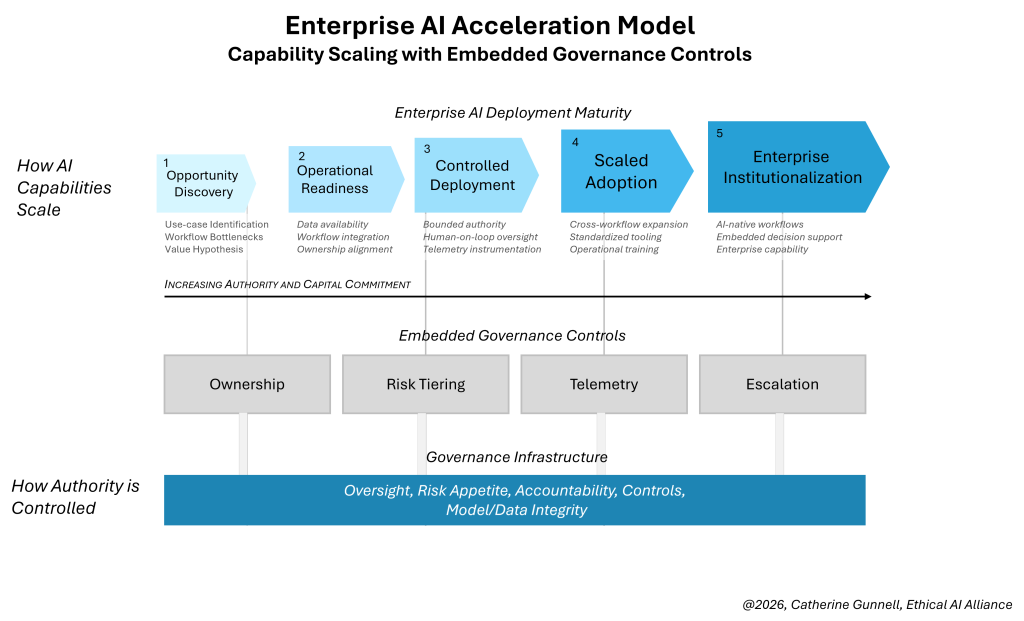
Over the past two years, most large organizations have experimented with AI. They’ve built pilots. Tested copilots. Run proofs of concept. Yet few organizations have successfully scaled AI into core operations. The problem isn’t the technology. The challenge in enterprise AI isn’t building the model. It’s building the operating architecture that allows the model to…
-
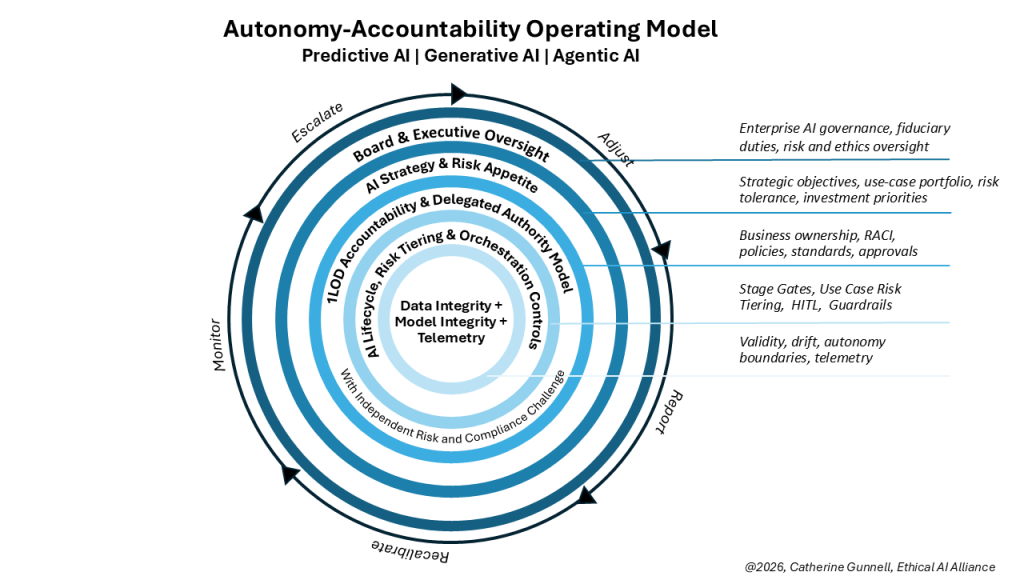
AI Governance Becomes Real in the Inner Rings
In the first post, I argued that AI governance starts with mandate, risk appetite, and first-line ownership — not with monitoring dashboards or validation checklists. That outer structure matters because it defines who has authority, what level of risk the institution will accept, and where accountability sits before AI discretion migrates into execution. This next…