Artificial intelligence governance is entering a structural transition—a tipping point.
For years, enterprises governed AI primarily through a model risk and compliance lens, reflecting systems that were predictive, bounded, and largely recommendation-driven.
But AI systems are continuing to evolve—far beyond and far faster than we expected.
Today’s enterprises deploy a spectrum of AI capabilities: predictive models, generative systems, and increasingly autonomous architectures embedded in operational workflows. These systems do more than suggest. They influence decisions, coordinate across systems, and in some cases initiate action.
As AI systems gain operational authority, governance must evolve in parallel.
Because whenever authority is delegated — explicitly or implicitly — accountability must be structured.
Not assumed. Structured.
The Structural Shift
Traditional governance models were built around:
- Human approval gates
- Linear development lifecycles
- Discrete validation checkpoints
- Retrospective monitoring
That architecture remains necessary. But it is no longer sufficient.
As AI systems become more integrated into enterprise workflows, governance must address new structural realities:
- Who owns the system end-to-end?
- Where does delegated authority begin and end?
- What is an escalation event?
- Is there a severity or risk assignment to that event?
- Can system decisions be reconstructed, evidenced, and explained under regulatory or audit scrutiny?
- And, possibly most importantly, how does oversight scale without stalling innovation?
These are operating model questions — not documentation questions.
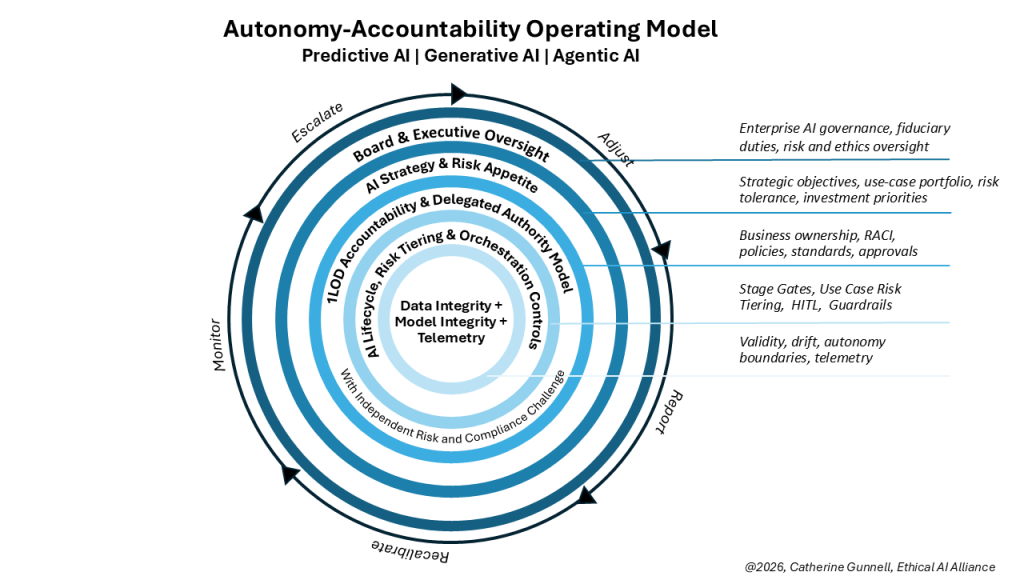
The Autonomy–Accountability Operating Model
The Autonomy–Accountability Operating Model is a layered governance architecture designed to align delegated AI authority with explicit ownership, risk-tiered controls, lifecycle oversight, and board-level transparency.
It applies across predictive, generative, and autonomous AI systems. Agentic AI simply stress-tests whether governance structures are truly durable.
The model organizes enterprise AI governance into five interlocking layers:
1. Board & Executive Oversight
AI governance is ultimately a fiduciary responsibility. Oversight must translate system behavior into aggregate exposure, risk posture, and strategic alignment.
2. Enterprise Strategy & Risk Appetite
AI deployments must align with enterprise objectives and clearly articulated risk tolerance. Velocity without calibrated risk creates fragility.
3. 1LOD Accountability & Delegated Authority
Business ownership must be explicit. Authority boundaries must be defined. Independent risk and compliance challenge must be embedded — not reactive.
4. Lifecycle, Risk Tiering & Orchestration Controls
Use case intake, structured risk tiering, stage gates, human-in-the-loop architecture, escalation thresholds, and orchestration guardrails ensure calibrated autonomy.
5. Data Integrity, Model Integrity & Telemetry
Governance ultimately depends on system validity, drift detection, boundary enforcement of autonomy, and reconstructable telemetry.
These layers operate continuously through a governance loop:
Monitor → Escalate → Adjust → Report → Recalibrate
This is not a compliance checklist. It is an operating discipline.
Governing for Durable Scale
As AI systems move closer to operational authority, governance becomes a structural design requirement.
Organizations that evolve their governance architecture deliberately will scale with confidence.
Organizations that fail to do so will find it harder to balance innovation and oversight, leading to mounting challenges.
Over the coming weeks, I will examine each layer of this operating model in greater depth — from risk appetite calibration to delegated authority design, lifecycle controls, telemetry architecture, and board-level oversight.
Because enterprise AI governance is not a policy artifact.
It is an operating system.
